
Post #1
Book to Movie: Oppenheimer
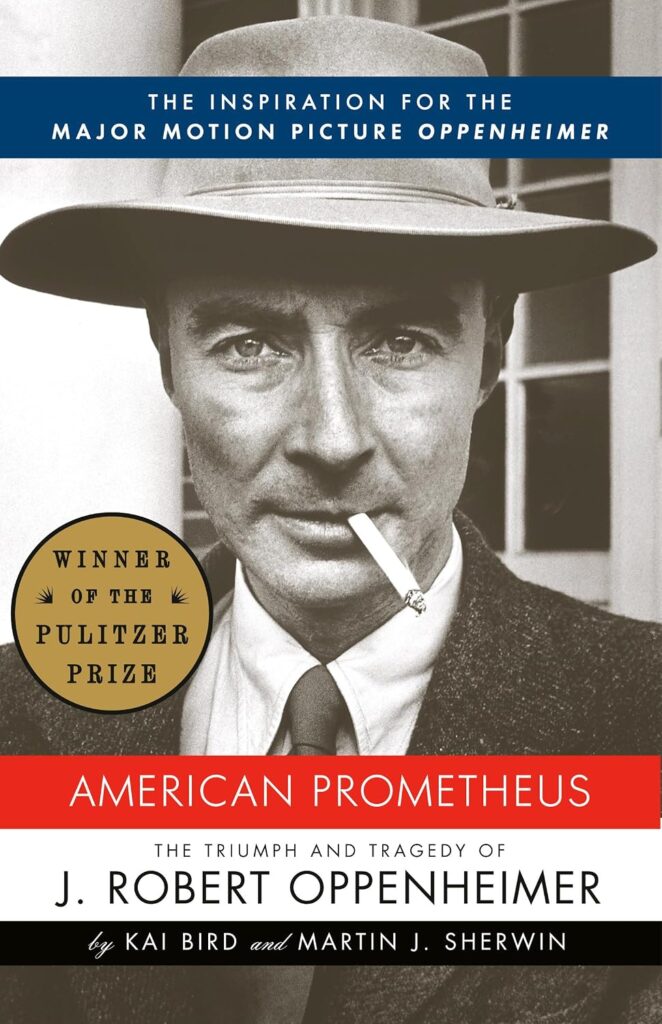

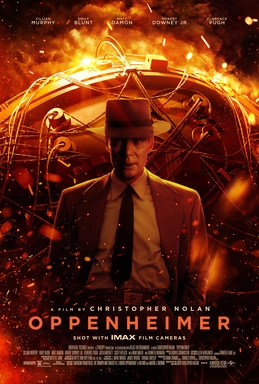
Few films arrive with the cultural force of Oppenheimer. Christopher Nolan’s adaptation of American Prometheus is an extraordinary achievement: intellectually ambitious, emotionally powerful, and visually arresting. It transforms a dense, 700-page biography of a theoretical physicist into a gripping three-hour film that rarely relies on conventional action, yet never loses its audience. The film succeeds on multiple levels simultaneously: as historical drama, political thriller, character study, and meditation on scientific responsibility. Like many viewers, I found it absorbing from beginning to end.
Audiences and critics clearly felt the same. Oppenheimer became both a critical and commercial triumph, earning widespread acclaim and generating nearly one billion dollars at the worldwide box office. The film went on to dominate awards season, winning seven Academy Awards, including Best Picture, Best Director for Christopher Nolan, Best Actor for Cillian Murphy, Best Supporting Actor for Robert Downey Jr., and Best Adapted Screenplay for Christopher Nolan. It also received major recognition from the BAFTAs, Golden Globes, Screen Actors Guild Awards, and numerous critics’ organizations. In an era often dominated by franchise filmmaking, Oppenheimer demonstrated that a serious, adult-oriented historical drama could still become a major cultural event.
Because of that success, Oppenheimer provides a fascinating case study in adaptation. What follows is not an attempt to diminish the film’s achievements or fault-find. Rather, it examines the choices Nolan made in translating American Prometheus from page to screen. As with my analysis of L.A. Confidential, I approach the film as a student of adaptation. Studying great adaptations is often more instructive than studying failed ones. By examining what Nolan chose to compress, omit, invent, and restructure, we gain insight into the craft of transforming a complex book into compelling cinema.
Put yourself in Christopher Nolan’s chair. You’ve just finished reading American Prometheus. Before writing a single page of screenplay, you face three adaptation challenges.
First: How do you compress more than 700 pages into a film that audiences can absorb in three hours?
Second: How do you dramatize a man whose greatest conflicts often happen inside his own mind? A biography can explain motives and contradictions. A film must reveal them through performance, images, editing, and sound.
Third: How do you convince an audience they have met the real Oppenheimer? A biography can examine a life from every angle. A film cannot. Every scene you choose, every scene you omit, and every relationship you emphasize becomes part of the portrait. The challenge isn’t simply telling Oppenheimer’s story. It’s deciding who Oppenheimer is.
Now let’s turn to the creative choices Nolan faced in adapting Oppenheimer. These choices shaped every frame of Oppenheimer. Over the coming posts, I’ll examine the major adaptation decisions Nolan faced, why he made them, and what each choice gained, sacrificed, or transformed.
Nolan’s first decision was the biggest: how much of Oppenheimer’s life should the film attempt to tell?
- Narrative Scope: What Slice of a Life?
The first and most consequential decision is how much life to show. Biopics generally fall into three modes:
The cradle-to-grave sweep (Gandhi, Ray, Ali) follows a subject from origin to death, treating the whole arc as the story. It is ambitious but punishing: the film either sprawls or skips.
The constrained window (Lincoln, Jackie, Spencer) picks a single compressed episode — days, weeks, a pivotal season — and finds universality in the particular.
The one-job/one-crisis biopic (Sully, The King’s Speech, Moneyball) isolates a single challenge and organizes everything around it.
Nolan refused the pure version of all three. He chose something closer to a dual structure: one job—the making of the bomb — and one crisis — the hearings that judge Oppenheimer afterward. This is not a life story. It begins in the 1920s, but it is not interested in young Oppenheimer for long. It is ruthlessly interested in two episodes — Los Alamos and the security hearing — and everything else exists to charge those two poles.
Once that boundary had been drawn, another question immediately followed: what narrative structure could hold the story together?
- Framing Device: What “Container” Holds the Story?
Even once you know what to show, you must decide how to hold it. Three dominant options exist:
The inquiry or trial frame (The Passion of Joan of Arc, The People vs. Larry Flynt) puts a formal proceeding at the center, using testimony to reveal the past.
The retrospective interview or journalist frame (Jackie, The Fog of War) gives a present-day narrator the authority to look back—with all the editing and self-myth-making that implies.
No explicit frame at all (Walk the Line, Frida) lets the events unfold, trusting the audience to find its own orientation.
Nolan chooses the first, emphatically. The 1954 security hearing becomes the film’s narrative anchor. However, the movie actually has two hearing structures. There is Oppenheimer’s 1954 security-clearance hearing and Strauss’s 1959 confirmation hearing, where Strauss’s treatment of Oppenheimer is indirectly put on trial.
In the next blog post, I will examine what Nolan gained by adding Strauss’s hearing, what he lost, and whether the tradeoff was worth it.