
Post #1
Book to Movie: LA Confidential
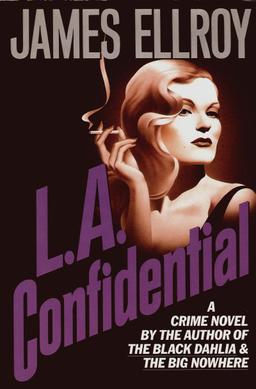

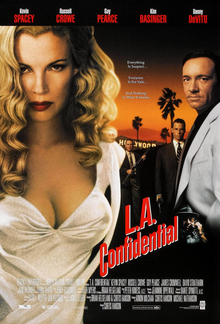
James Ellroy once described the adaptation of L.A. Confidential with pride and seasoned realism. Speaking to Michael Sragow of the Dallas Observer, he observed that Curtis Hanson and Brian Helgeland “preserved the basic integrity of the book and its main theme: that everything in Los Angeles during this era of boosterism and yahooism was two-sided, two-faced, and cosmetically packaged.” The screenplay, he noted, centers on men evolving under sustained pressure. Most revealing of all, Ellroy pointed out that Hanson and Helgeland reduced a novel built on eight plotlines to three, yet retained its dramatic power by shaping the narrative around three men working through their destinies.
That observation quietly contains the entire adaptation challenge of L.A. Confidential. Ellroy’s novel is not merely complex. It is aggressively crowded, a collision point where corruption, ambition, violence, and self-invention converge from every direction. To understand what Hanson and Helgeland achieved, we first need to confront the scale of what they inherited.
Before examining what the film becomes, this analysis begins with what the novel is: eight distinct plotlines pulling Los Angeles apart at the seams. Only by mapping those threads can we see which survive intact, which are fused together, and which are sacrificed so the film can move with purpose.
I analyze the plotlines chronologically, even though Ellroy does not present them that way. This approach clarifies causality. In L.A. Confidential, nothing unfolds by accident. Power accumulates, money circulates, and bodies fall in a deliberate sequence.
Plotline 1: The Mickey Cohen Gang War and the Stolen Heroin (1950–1952)
This plotline functions as the novel’s ignition switch. It reveals how Dudley Smith acquires the money, narcotics, and leverage that fuel every later scheme. More importantly, it marks the moment he is quietly installed as the dominant criminal force operating within Los Angeles.
The chain begins on February 21, 1950. Buzz Meeks, an associate of mobster Mickey Cohen, steals eighteen pounds of high-grade heroin and $94,000 during a narcotics summit. Meeks is not simply fleeing Cohen’s retaliation. He is also on the run from the LAPD after killing a police officer, making his situation both precarious and finite.
For a week, Meeks evades pursuit. His solution is temporary at best. He hides the heroin and cash with the sons of Doc Engleking, trusting them to sell the product later and deliver his share. They send him to the El Serrano Motel and arrange passage to Guatemala City, a plan that collapses the moment Dudley Smith enters the equation.
Cohen’s enforcers, alongside Mal Lunceford, a former patrolman working for Smith, locate Meeks. After a prolonged shootout, Lieutenant Smith arrives wearing a fire department greatcoat, signaling that he had been monitoring the summit from the outset. The corruption is not opportunistic. It is premeditated.
Smith executes Meeks and takes possession of the heroin and cash. With a single calculated act, he secures both capital and product, the twin engines behind his later partnership with Pierce Patchett. This is not merely a gangland episode. It is the structural foundation of Smith’s power and the novel’s first declaration that Ellroy is writing about systems rather than isolated crimes.
Plotline 2: The “Bloody Christmas” Police Scandal
The Bloody Christmas plotline anchors the novel in historical reality while exposing the LAPD’s moral fault lines with precision. Ellroy draws directly from documented events, reminding readers that this narrative is entangled with lived history rather than loosely inspired by it.
On December 25, 1951, intoxicated on-duty officers brutally assault seven civilians, most of them Mexican American or Black detainees. Among the officers involved are Bud White and his partner Dick Stensland, whose participation shapes their futures in radically different ways.
Sergeant Edmund Exley, acting as assistant watch commander, recognizes the scandal not as a crisis but as an opening. He drafts multiple incident reports, carefully redistributing blame toward officers nearing retirement and toward rivals such as White and Stensland. He then volunteers to testify as the department’s key witness, positioning himself as a reformist voice. His testimony earns praise from Chief Parker, Ellroy’s fictionalized counterpart to LAPD Chief William H. Parker.
White responds differently. His loyalty overrides calculation. When Dudley Smith offers to secure Stensland’s pension in exchange for testimony against him, White refuses. It is one of the rare moments of personal integrity within a system governed by negotiation.
Smith ensures that integrity carries consequences. He orchestrates recanted testimonies that spare White from indictment while binding him more tightly to departmental compromise. Survival requires compliance, not virtue.
The fallout reshapes careers. Seven officers face indictment or dismissal. Exley rises quickly to Sergeant. White is suspended before being reassigned to Surveillance under Smith’s guidance. Stensland falls furthest. Indicted, dismissed, and driven into violent crime, he is eventually convicted of multiple robberies and murders and executed at San Quentin.
Narratively, Bloody Christmas acts as a sorting mechanism. It establishes hierarchy, reveals character, and demonstrates how power structures reward ambition while disciplining independence.
Plotline 3: The Hush-Hush Tabloid Blackmail Scheme
This plotline exposes the merger of celebrity culture, journalism, and policing into a single profit engine. Through the scandal magazine Hush-Hush and its operator Sid Hudgens, information becomes currency and humiliation becomes leverage.
Hudgens exerts control over Sergeant Jack Vincennes through the 10-47 “Malibu Rendezvous” double homicide. On October 21, 1947, Vincennes conducts a narcotics stakeout while impaired by alcohol and marijuana. During the ensuing chaos, he mistakenly kills two Iowa tourists.
The department conceals the truth. The victims are blamed on drug traffickers, and Vincennes emerges publicly celebrated. Officially, the case is closed. Unofficially, it remains a vulnerability known to Dudley Smith and fully exploited by Hudgens.
Hudgens forces an arrangement. Vincennes tips him off before arresting celebrity users, guaranteeing sensational coverage. The blackmail remains unspoken yet absolute. In exchange, Vincennes cultivates a polished image as the media’s “Dope Crusader.”
Hudgens amplifies this image by securing Vincennes a paid consulting role on the television series Badge of Honor, Ellroy’s fictional analog to Dragnet. Vincennes becomes performance as much as policeman, his identity curated while his past sits archived in Hudgens’s files.
The operation expands beyond celebrity scandal. Hudgens manipulates political outcomes and partners with Pierce Patchett, leveraging access to elite clientele for further extortion. Information circulates. Influence accumulates.
The system collapses in April 1953 when Hudgens is murdered and his files stolen by David Mertens. Secrets scatter. Ellroy’s Los Angeles reveals its governing principle once again: gossip is simply delayed violence waiting to surface.